The Event App Nobody Opens: What's Really Behind It

The Event App Nobody Opens: What's Really Behind It
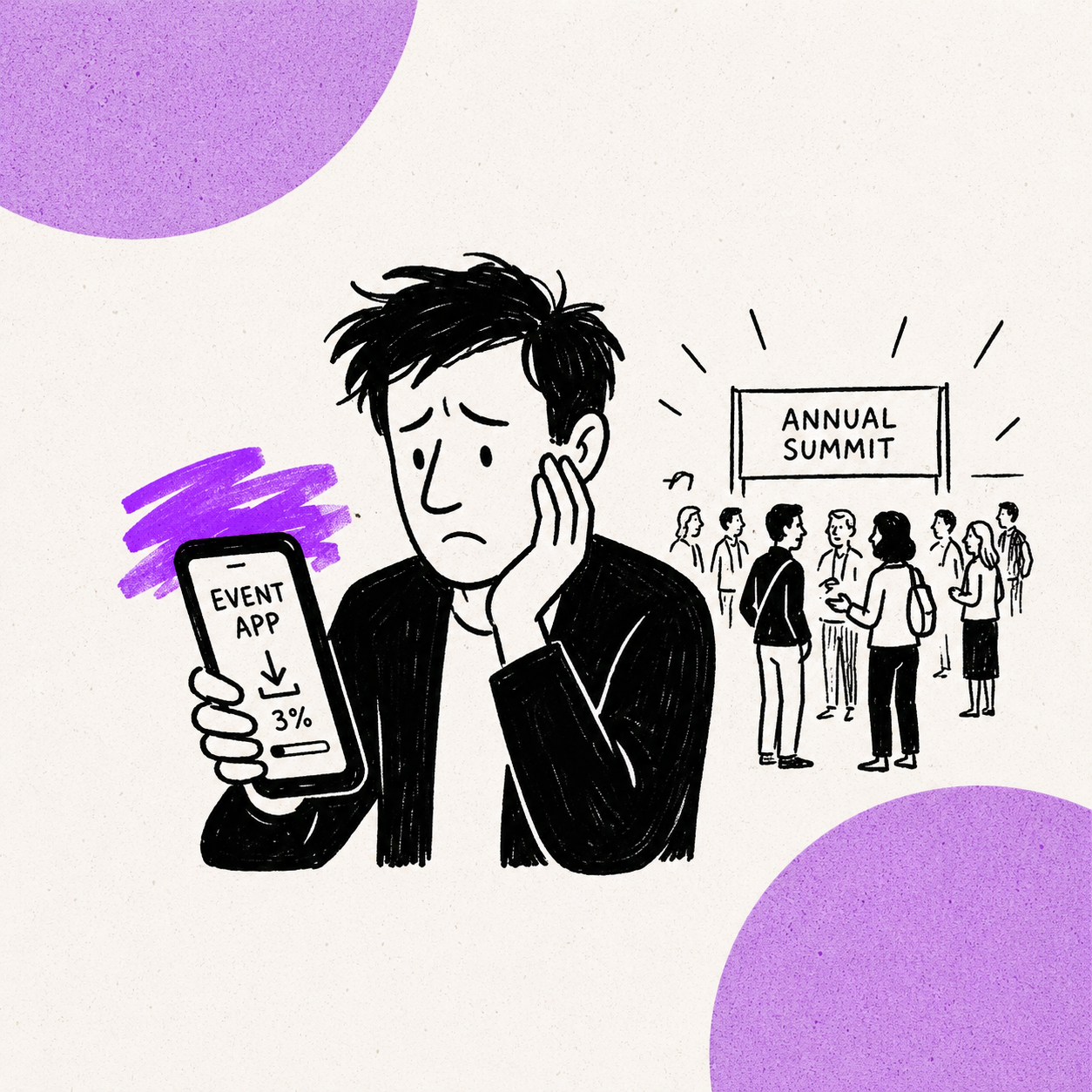
Few investments look as promising on paper as a dedicated event app, and few disappoint in practice as often. After the event, the numbers tell the same sobering story: only a fraction of attendees ever opened the app, and an even smaller share actually used it during the event itself. The budget was there, the announcement was in the invitation too, but almost nobody used it.
For many organizers, that's a familiar but unresolved frustration. You invested in a tool meant to improve orientation, networking, and program overview, and in the end attendees seem to stick with the good old printed program or a WhatsApp group instead.
This experience repeats year after year, often with a new provider, a new design, and the same disappointment at the end. The obvious response, simply switching providers, usually falls short, because it misses the actual core of the problem.
The problem is rarely usability alone
The obvious explanation is usually: the app was too complicated, the design too cluttered, the load times too long. That may be true in individual cases, but it doesn't explain the actual pattern that repeats across many events and many different apps: even technically flawless, well-designed apps often go largely unopened.
The real reason runs deeper, in the question of why an attendee should download an additional app at all, for an event that might only last a single day. For many attendees, the download and setup effort is out of proportion to the perceived benefit, especially when the same information is available elsewhere, such as by email.
A look at the usage numbers almost nobody shares publicly
Most organizers are reluctant to talk publicly about their event app's actual usage numbers, because in hindsight they're embarrassingly low. Internally, though, very different numbers often circulate than the success story told to sponsors: a download rate well below the number of attendees, and daily usage that drops off rapidly after the first event day.
This pattern repeats so consistently, regardless of industry, event size, or chosen provider, that it can barely be called an exception anymore, more a norm. That's exactly what makes it so important to understand the actual causes, instead of hoping once again at the next event that this time will be different.
A chicken-and-egg problem at launch
On top of that comes a structural chicken-and-egg problem: an event app often only delivers its real value once many attendees use it at the same time, for example for networking features or live polls during a talk. But as long as only a small share of attendees have installed the app at all, that network effect never kicks in, which in turn lowers the motivation for the remaining attendees to install it later.
This pattern reinforces itself from event to event, once attendees have already learned from past experience that it's rarely worth the effort. Anyone who downloaded an app at a previous event that turned out to be an empty marketing gimmick simply won't bother downloading the next one at all.
Why the problem is rarely addressed openly
Within many organizations, low app usage is rarely discussed openly, because it raises uncomfortable questions about the original investment decision. Whoever introduced the app has little interest in admitting afterward that the usage numbers were disappointing. Instead, the app usually just keeps running the following year, without anyone seriously questioning the actual cause.
This quiet continuation without any real reckoning is one of the main reasons the problem persists across entire industries for years, instead of being solved through targeted improvements.
What a single look at the usage data would reveal
If many organizations actually took an honest look at their own event app's usage data, the pattern would usually be impossible to miss: a download rate well below the actual number of attendees, daily usage that visibly drops off as early as the second event day, and a large share of features that are practically never opened.
Anyone willing to face that look, instead of avoiding it, gains exactly the starting point needed for a better decision later on. Without that honest look, every new app rollout remains a shot in the dark, no matter how convincing the next sales pitch sounds.
Many teams shy away from even actively looking at these numbers, out of concern they'll confirm an uncomfortable result. Yet that exact number is the single most important starting point for any improvement: without knowing how poor current usage actually is, it's hard to judge whether a new app really makes a difference.
The real food for thought
The decisive question, then, isn't how to make an event app look more appealing. It's which criteria actually determine whether an event app plays a real role in attendees' daily experience, instead of disappearing unused on the home screen.
Anyone who knows these criteria can ask about them directly in the very first conversation with a provider, instead of being guided solely by a convincing-looking product demo. That's exactly what keeps the next app from suffering the same fate as the last one.
Which ten criteria are meant to prevent exactly that when choosing an event app is covered in the next article.
Continue reading: Choosing an event app, the 10 criteria that keep it from going unused.
Sign up for the talque newsletter now.




.webp)
.webp)