Accreditation vs. Ticketing: Where the Difference Really Lies for Trade Fair Organizers

Many organizers treat accreditation and ticketing as the same topic under a different name. Anyone with a ticketing tool often assumes that entry is automatically taken care of too. In practice, though, these are two different tasks with different requirements, and this mix-up is one of the most common reasons for problems on event day.
At first glance the difference looks academic, but it becomes very concrete as soon as an event grows beyond the simplest basic form. Anyone who discovers this difference only on event day usually no longer has time to solve it cleanly.
Two tasks that often get lumped together
At its core, ticketing answers an economic question: who has paid, and what access has that person purchased. Accreditation answers a different question: is this person actually who they claim to be, and are they allowed to be at this specific place at this specific time. The first question is commercial, the second is a matter of verification and often also legal compliance.
At a small company event with a manageable guest list, this difference rarely stands out, because both questions practically have the same answer. At a large trade fair with exhibitors, press, trade visitors, and different access levels, the difference quickly becomes decisive.
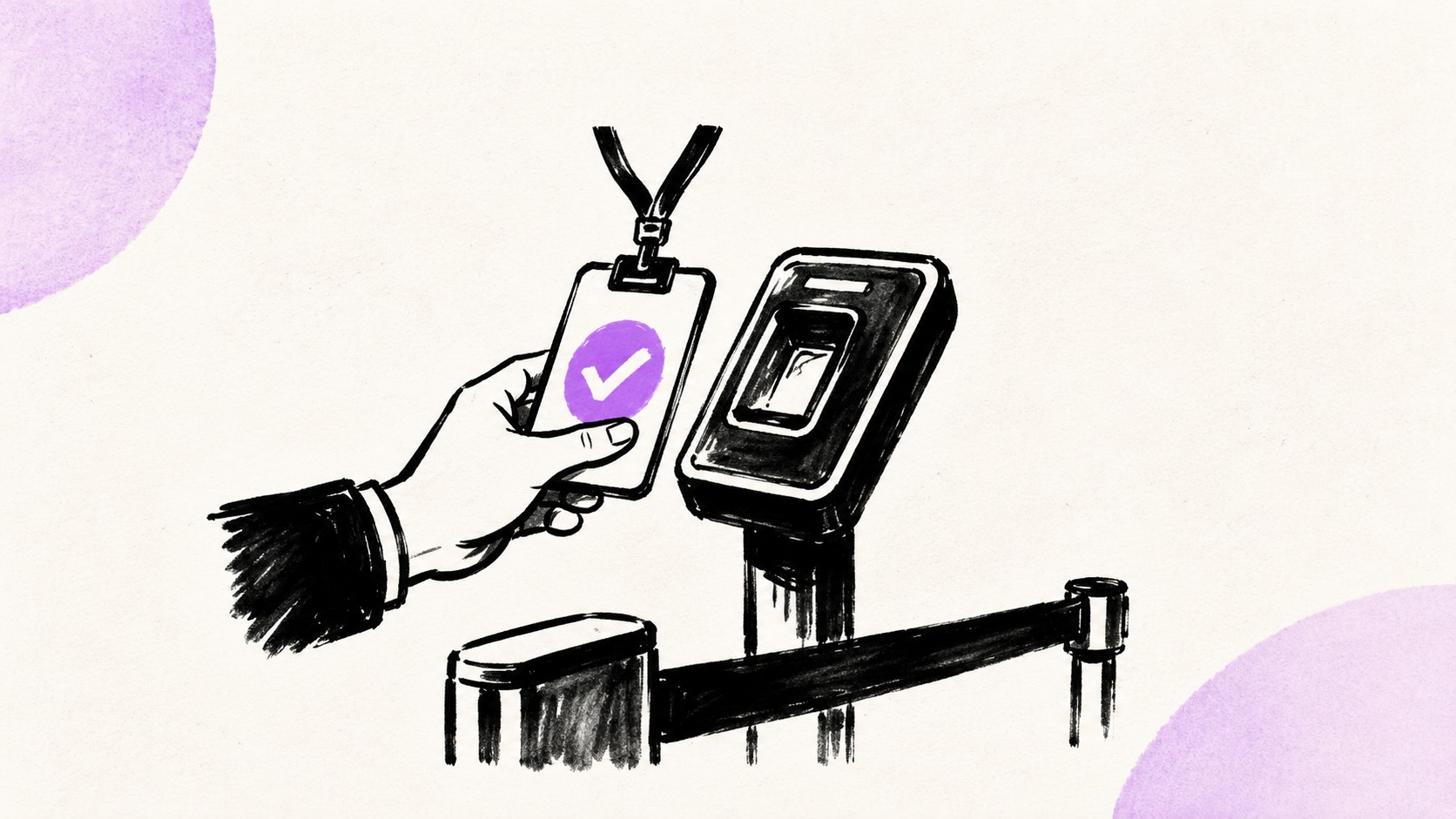
A helpful comparison: ticketing is like the receipt from a purchase — it proves that payment was made. Accreditation is like the ID at the door — it proves who is actually coming in. Both documents answer different questions, even if they're needed in the same place, and in practice both are often the responsibility of different people on the team.
How to tell you actually need accreditation
- There is more than one access level, for example general visitors, trade visitors, press, and VIP areas.
- Access has to be tied to a specific, verified person, not just a purchased ticket.
- There are legal or security-related requirements for entry, for example at trade fairs with restricted access.
- Some accreditations are issued free of charge, independent of any payment, for instance to press or partners.
- Entry has to remain traceable even when no purchase in the classic sense has taken place.
If at least one of these points applies to your event, a pure ticketing tool usually isn't enough, even if it appears to check every box on a checklist at first glance.
Interestingly, the real need for accreditation often only develops over time. An event that got by with a single ticket type in its first year can suddenly have press inquiries, sponsor allotments, and a VIP lounge by its third year, without anything having changed about the underlying system.
Why this mix-up is so common in practice
Many ticketing providers advertise add-on features like guest lists or check-in apps under the umbrella term entry management. That sounds like a complete solution, but it often only covers the simple case: one ticket, one scan, done. As soon as press accreditation, tiered access rights, or identity verification come into play, the gap becomes visible.
This gap rarely shows up in the sales pitch, because that usually presents the simplest use case. Only once an organizer tries to map press accreditation or a tiered VIP arrangement in the same system does it become clear that it wasn't built for that actual need.
What often results is a patchwork of workarounds: a spreadsheet for the press list, a separate arrangement for VIP guests, another solution for exhibitor allotments. Each of these workarounds works on its own, but no one keeps the full overview once all of them are needed at the same time.
What's often underestimated during the switch
Organizers switching from pure ticketing to real accreditation often don't underestimate the technology, but the organizational rework that comes before it. Anyone who has been collecting press requests by email has to first cleanly translate that process into access levels before any system can benefit from it. This groundwork pays off because it's usually overdue anyway, regardless of which software is chosen.
A second point that's often considered too late is communication with the different access groups themselves. Press, sponsors, and regular participants expect different information ahead of the event. An accreditation solution that can handle this separately makes this part significantly easier too, not just entry on the day itself.
What a real accreditation solution should deliver
- Verification of individual people's identity, not just matching a ticket code.
- Multiple, clearly separated access levels with different permissions.
- Traceability even for access that didn't come from a purchase.
- Legally compliant logging of who had access to what and when, especially for security-relevant formats.
A practical example from the association world
An association with an annual members' meeting often has not only voting members but also guests, press, and external speakers on-site for a day. Each of these groups needs different access, some with voting rights, some purely informational. If this is mapped through a single ticket type, confusion regularly arises at entry about who is actually entitled to vote and who isn't.
With real accreditation logic, this distinction can be cleanly established already at registration, instead of having to sort it out by hand at the entry desk. This doesn't just ease check-in itself, it also helps with later analysis, for example when determining whether a quorum was reached.
What this means concretely for choosing software
When choosing a new solution, it's worth explicitly asking about the word accreditation, not just entry management. Many providers use these terms loosely, and only a concrete follow-up question reveals whether there's actually verification logic behind it or just a simple ticket scan under a different name.
A good test question in a sales conversation: how would the system handle press accreditation that's only confirmed the day before and never went through a regular ticket purchase? Providers who can answer this fluently and concretely have usually thought this through properly. Providers who dodge the question or point to custom development often haven't.
Checklist for your own assessment
Before planning your next event, ask internally:
- Do we have more than one access level that needs to be cleanly separated technically?
- Are there types of access that don't come from a ticket purchase, such as press or partners?
- Do we need to be able to prove afterward who had access, and when?
As soon as one of these questions is answered with yes, it's worth taking a closer look at whether your current system really delivers accreditation or just ticketing with an extra label.
It's also worth looking back at your last event: were there edge cases that had to be solved outside the actual system, for example by phone call, handwritten list, or a last-minute arrangement right at the entrance? Every one of these edge cases is a sign of where the current system's limits actually lie.
Conclusion
Ticketing and accreditation answer two different questions, even if they often look like a single step at the entrance. Anyone who recognizes this difference early in planning avoids unpleasant surprises shortly before the event, when a press list or a special VIP rule suddenly has to be squeezed into the existing system.
The difference can't be measured by an event's size alone, but by the variety of its access levels. A small but multi-layered event can need just as much accreditation logic as a large but simply structured trade fair. That's exactly why the assessment from this article is worth doing for practically every organizer, regardless of current event size.
What a solution looks like that treats accreditation as its own task from the start is shown in the next article.
In the end, one thing matters most: that no one has to improvise at entry because an edge case wasn't accounted for in the system. That's exactly what can be avoided long before event day through the right software decision, not just by adding staff on the day itself.
Continue reading: talque Accreditation, verified access for trade fairs and associations.